Spend 10–15 minutes preparing for your next workout with this simple, evidence-informed warmup.
How do you typically warm up before workouts? Do you jump straight into your first exercise, spend several minutes stretching, or hop on a treadmill without a plan?
A warmup should have a purpose. The goal is to prepare your body for the demands of your workout by gradually increasing activity, rehearsing the movements you will perform, and building toward the loads you plan to lift.
One way to structure your warmup is the RAMP method: Raise, Activate, Mobilize, and Potentiate.
Below, we'll break down each phase and show you how to apply it before your next workout.
What Is the RAMP Method?
RAMP is a four-part warmup framework designed to prepare you for physical activity. Each phase has a specific purpose:
Raise: Increase heart rate and body temperature through light activity.
Activate: Prepare the muscles involved in your upcoming workout.
Mobilize: Move through the ranges of motion needed for your exercises.
Potentiate: Gradually increase the intensity and specificity of your movements before your working sets.
Let's look at how to put each phase into practice.
1. Raise
Goal: Increase heart rate and body temperature.
Start with 3–5 minutes of light cardiovascular activity. This helps you transition from rest to exercise and prepares you for the work ahead.
Choose an activity you enjoy and can perform comfortably.
Examples include:
Brisk treadmill walk
Rower
Assault bike
Keep the intensity relatively light. You should feel warmer and notice a slight increase in your breathing without feeling fatigued.
You want to be ready to train, not tired before your workout begins.
2. Activate
Goal: Prepare the muscles involved in your workout.
The activation phase uses simple exercises to rehearse movements and prepare the muscles you'll use during your training session.
Keep the movements controlled and use a resistance level that allows you to maintain good technique.
These exercises are options, not mandatory prerequisites for a successful workout. If your training session has different demands or you have specific limitations, you can adjust your exercise selection accordingly.
Lower-body examples:
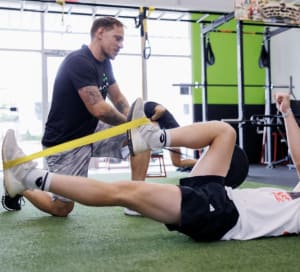
Banded side-steps
Banded monster walks
Glute bridges
Upper-body examples:
Banded A's, T's, and Y's
Incline push-ups
Banded thoracic rotations
3. Mobilize
Goal: Prepare the ranges of motion you'll use during your workout.
Mobility work should help you access the positions required for your exercises. For a typical lower-body session, that may include movements involving the hips, knees, ankles, and trunk.
Rather than performing every mobility drill you know, choose a few movements that are relevant to your upcoming workout.
Lower-body examples:
Lunge with rotation
Hip 90/90s
Quadruped hip circles
Upper-body examples:
Bench thoracic extensions
Wall slides
Half-kneeling thoracic rotations
4. Potentiate
Goal: Bridge the gap between your warmup and your first working set.
You've raised your heart rate, prepared your muscles, and rehearsed the movements you'll use. Now it's time to gradually increase the demands placed on your body.
Start with your first primary exercise, such as a squat, deadlift, or bench press. Perform progressively heavier warmup sets before beginning your working sets.
Example: Preparing for a squat
If your working weight is 225 pounds, your progression might look like this:
Empty bar: 10 repetitions
95 pounds: 5 repetitions
135 pounds: 3–5 repetitions
185 pounds: 2–3 repetitions
Begin working sets at 225 pounds
Adjust the number of warmup sets and repetitions to your needs and the demands of your workout.
Common Warmup Mistakes
1. Doing too much before the workout begins.
Your warmup should prepare you for training without creating unnecessary fatigue. You don't need a long list of exercises to have an effective warmup.
2. Treating mobility as a one-size-fits-all solution.
Not everyone needs the same mobility drills. Choose movements that address your individual needs and the demands of your workout.
3. Skipping progressive warmup sets.
A few band exercises and bodyweight squats do not replace practicing your primary lift with gradually increasing loads. Specific warmup sets help you prepare for the movement and intensity ahead.
4. Using the exact same routine for every session.
A squat-focused workout, a deadlift-focused workout, and a plyometric session have different demands. Keep the RAMP framework, but adjust the details to match the session.
Key Takeaways
A good warmup doesn't need to be complicated. It needs to prepare you for the work you're about to do.
Remember the four phases:
Raise your heart rate and body temperature.
Activate the muscles involved in your session.
Mobilize the ranges of motion you'll need.
Potentiate by progressively preparing for your first working set.
Start with this routine, make adjustments based on your needs, and use your warmup to transition into training with purpose.
Squat Day Warmup
Phase
Exercise
Dosage
Raise
Treadmill, rower, or bike
3–5 minutes
Activate
Banded side-steps, monster walks
10 each way
Activate
Glute bridges (single or double leg)
10 reps
Mobilize
Half-kneeling thoracic rotations
10 each way
Mobilize
Knee-to-wall ankle rocks
8 per side
Mobilize
Deep squats
10 reps
Potentiate
Progressive barbell squat warmup sets
3–5 sets as needed
Focus: Prepare the ankles, hips, and trunk for the squat pattern, then progressively expose the body to the loads required for the working sets.
Deadlift Day Warmup
Phase
Exercise
Dosage
Raise
Treadmill, rower, or bike
3–5 minutes
Activate
Bird dogs
10 each side
Activate
Banded squats
10–15 reps
Mobilize
Half-kneeling thoracic rotations
10 each way
Mobilize
Dowel hip hinges
8 per side
Mobilize
Quadruped rock backs
10 reps
Potentiate
Progressive deadlift warmup sets
3–5 sets as needed
Focus: Rehearse the hip hinge, trunk control, and starting position needed for deadlifting. Adjust the mobility work to the specific pull, whether conventional, sumo, or Romanian deadlift.
Chest or Shoulder Day Warmup
Phase
Exercise
Dosage
Raise
Rower, assault bike, or ski erg
3–5 minutes
Activate
Resistance band series (external/internal rotations, A's, T's, Y's)
10 each
Activate
Push-ups (elevated hands if needed)
10–15 reps
Mobilize
Half-kneeling thoracic rotations
10 each way
Mobilize
Bench thoracic extensions
8 per side
Mobilize
Wall slides
10 reps
Potentiate
Progressive bench or overhead press warmup sets
3–5 sets as needed
Focus: Prepare shoulder elevation, scapular movement, and thoracic positioning for pressing. Select the potentiation exercise based on the first primary lift of the session.
Ready to Build a Better Training Program?
Need help building a training program around your goals? At ADAPT Performance and Training, we combine physical therapy expertise with performance-focused training to help you move well, build strength, and keep progressing toward your goals.